
Daily Digest
Pick model for what it knows, effort for how involved you want to be
Model for what it knows. Effort for how involved you want to be.
The problem
Two knobs feel like "make it smarter": which model, and how much effort. People mash them together. They bump the bigger model when the agent skipped a file. They slam effort to max for a subject-line brainstorm. They never touch low because it sounds like dumb mode.
Those are different dials. Mixing them up burns tokens, slows you down, and still leaves the miss.
Anthropic's Claude Code write-up splits them cleanly. A practical effort playbook (Ben / Tariq guidance) adds which effort for which job, and why low is useful more often than people think. This piece turns that into a decision tree you can run by hand — or automate with a hook (companion technique).
The technique
Model picks which frozen weights run the request — the capability ceiling. Your prompt steers that turn; it does not retrain the weights.
Effort picks how much work happens before check-in: files read, tests run, double-checks, and how many decisions the agent makes alone. It is also an involvement dial: lower comes back sooner and asks more; higher goes off and decides for you.
Default to the model's default effort for most work (often medium on current Opus). Fix vague prompts before raising effort.
When something goes wrong, ask:
Did it not know enough, or did it not try hard enough (or did you want a different involvement level)?
- Not know enough → larger model
- Not try hard enough → higher effort
- Want faster steering / simple / polish → lower effort
Decision tree
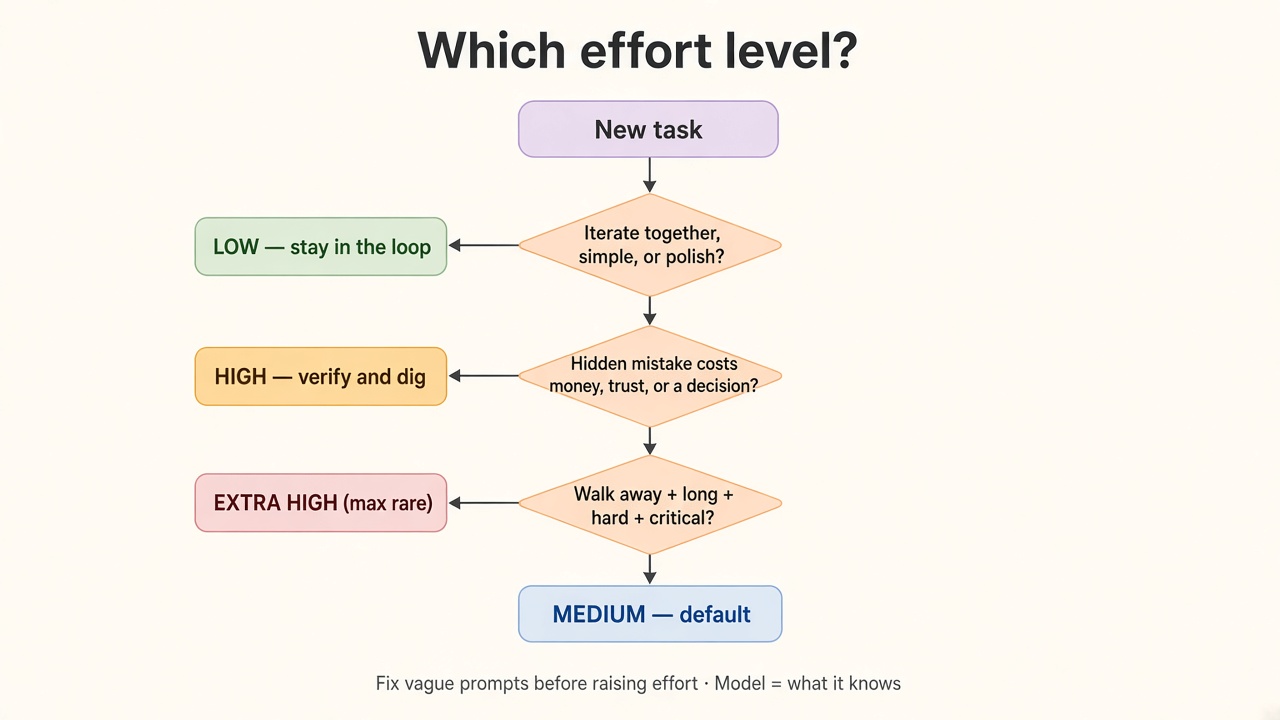
Stop at the first yes:
- Iterate together, simple ask, polish pass, or clear rubric batch? → Low
- Hidden mistake costs money/trust/a decision — or open-ended dig with no set path? → High
- Walk away + long + hard + critical (all true)? → Extra high (try before max)
- Else → Medium
| Level | When | What to expect |
|---|---|---|
| Low | Iterate; simple; polish; rubric batch | Fast first version; asks more; does exactly what you asked — use a short checklist for multi-part asks |
| Medium | Done is clear; review once; everyday writing/reports/repurpose | Default. If it misses, improve context before raising effort |
| High | Verification; edge cases; open-ended analysis; final check after a low build; skills that will repeat | More approaches and checks; slower return |
| Extra high / Max | Walk-away + long + hard + critical | Hours possible; many autonomous decisions. Max often adds cost for small gains and can overthink |
Money-saving pattern: build on low, switch to high only to verify.
Automate the decision
Wire defaults, then reminders, then task-type overrides. Full auto-set of effort from a prompt classifier is still limited in the products — Claude Code hooks can suggest (and some kits write effortLevel into settings), but they cannot return a new effort field from the hook API yet.
| Layer | Claude Code | Cursor |
|---|---|---|
| Default | effortLevel / modelSettings | Default model + usual thinking effort |
| Remind / suggest | UserPromptSubmit hook or CLAUDE.md | Always-on .cursor/rules printing RECOMMEND: |
| Enforce for a task type | Skill/subagent effort: frontmatter | @draft / @verify rules + you pick the picker |
| Walk-away jobs | --effort xhigh + written brief | Cursor Automations with a strong model |
Companion technique: how to build the suggest hook for both tools (with a validated kit).
What we saw
Small test, 31 Oct 2026 — Cursor-style rule + effort simulation on a local fixture (not Anthropic's bench, not a full IDE UI run).
Classifier (16 gold prompts)
Hand-applied tree: 14/16 exact. Blind pass with only the rule file: 15/16 exact. Misses taught the wording: rubric batch belongs on low; one-shot repurpose stays medium unless you said you will iterate; open-ended "why did X?" belongs on high.
Reconcile microtask (report said refunds $30 / net $520; Stripe CSV had $50 / $500; report said trust the summary)
Low (1 approach) and high (2 approaches) both caught the mismatches. High added a second method and named the misleading note. The $20 gap was obvious — high won on depth, not catch-vs-miss. For outcome evidence that effort changes success rates, prefer Anthropic's multi-hypothesis data-analysis case (low wrong every time; high 4/5).
Concrete examples
Low: 15 subject lines; shorten an email; tag tickets by rubric; polish a finished dashboard.
Medium: follow-up from call notes; transcript → LinkedIn; weekly report in a known format.
High: Stripe reconcile; "why did churn rise?"; contract edge cases; final number check; build a reusable skill.
Extra high: unattended year of tickets → cancel reasons + ICP + roadmap; 50-page agreement before sign.
Model still matters: rename-a-prop → smaller model; auth design → larger model; hallucinated API with docs in context → larger model, not more effort; half-finished refactor → higher effort, same model.
Limits
- Bad context first. Dials will not save a vague brief.
- Product defaults move; keep the split and the tree.
- High predisposes more checking; it does not guarantee coverage.
- Max can overthink. Prefer extra high before max.
- Our reconcile fixture was too easy to prove low-vs-high catch rates.
Try it
- Set default effort (or Cursor thinking) to medium.
- Drop the tree into
CLAUDE.mdor.cursor/rules/effort-model.mdc. - Add one low path (draft skill/rule) and one high (verify).
- Build one real deliverable on low, verify on high — compare time to doing it all on high.
Sources
- Lydia Hallie, Choosing a Claude model and effort level in Claude Code
- Using Claude Code: Spending your effort — Terminal-Bench cases (GSEA proteomics: low 0/5 → high 4/5)
- Claude Code model configuration
- Ben (AI agency / community) effort walkthrough + Tariq low→iterate / high→verify practice (video transcript, Oct 2026)
- Cursor Rules, Cursor Automations
Did it work for us?
Partly
A blind pass of the rule file sorted 15 of 16 prompts right, but our reconcile test was too easy to show high effort catching more than low.